If you’re investing in Google Ads, now is the ideal time to step back and evaluate your performance.
The digital advertising landscape has changed significantly in 2026. Australian consumers are spending more cautiously, marketing budgets are under increased pressure, and AI now influences nearly every aspect of Google Ads. At the same time, search behaviour is evolving as platforms like ChatGPT, Gemini, and Google’s AI Overviews become part of the customer journey.
With so much changing, one important question remains:
Is your Google Ads budget delivering the best possible return?
This guide will help you review your campaigns, identify missed opportunities, and ensure your advertising strategy is aligned with your business goals for the remainder of the year.
Rather than rushing through each section, take a few moments to honestly answer the questions provided. Whether you manage your campaigns yourself or work with a marketing agency, these questions can help uncover areas for improvement.
At the end of this guide, you’ll also find a practical Google Ads Audit Checklist to help you evaluate your account and prioritise your next steps.
1. Is Your Google Ads Strategy Still Supporting Your Business Goals?
Many businesses continue running campaigns that were created months—or even years—ago without reviewing whether they still match their current objectives.
Perhaps you’ve introduced new services, shifted your target audience, increased prices, or changed your focus from rapid growth to higher profitability.
If your business has evolved, your Google Ads strategy should evolve with it.
Ask Yourself:
- What are our biggest business goals for the rest of 2026?
- Are our current Google Ads campaigns helping us achieve those goals?
- If we built this account from scratch today, would we structure it the same way?
A successful Google Ads account should reflect where your business is today—not where it was when the campaigns were first launched.
2. Are You Attracting the Right Customers?
High click numbers may look impressive, but they don’t always translate into business growth.
The most successful campaigns aren’t the ones generating the most traffic—they’re the ones bringing in qualified customers who are ready to buy.
Improving lead quality is often more valuable than simply increasing lead volume.
Ask Yourself:
- Which campaigns generate our highest-quality customers?
- Are we paying for enquiries that rarely convert?
- Which campaigns consistently produce profitable results?
- Where are we spending money without seeing meaningful returns?
In many cases, improving your Return on Ad Spend (ROAS) doesn’t require a larger budget. It simply means allocating more of your budget toward campaigns that already perform well.
3. Is AI Making Your Campaigns Better?
Artificial Intelligence now powers much of Google’s advertising platform.
From Smart Bidding and Performance Max to automated ad creation and audience targeting, AI is making more decisions than ever before.
The key isn’t whether you’re using AI—it’s whether AI is actually improving your results.
Ask Yourself:
- Which AI-powered features are currently active in our account?
- Which decisions are still being made manually?
- Have Google’s automated tools improved our performance?
- Are we regularly reviewing AI recommendations rather than accepting every suggestion?
AI works best when combined with a clear business strategy, accurate conversion tracking, and ongoing human oversight.
4. Is Your Website Holding Back Your Google Ads Performance?
Google Ads can generate visitors—but your website is responsible for converting those visitors into customers.
If people are clicking your ads but not taking action, the issue may lie with your landing pages rather than your campaigns.
Your website should clearly communicate your value, build trust quickly, and make it easy for visitors to enquire or purchase.
Ask Yourself:
- Does our website clearly explain why customers should choose us?
- Are our landing pages relevant to the ads visitors clicked?
- Is it easy for visitors to contact us or make a purchase?
- Have we recently reviewed page speed, mobile usability, and user experience?
Even small improvements to your landing pages can significantly increase conversion rates without increasing your advertising spend.
5. Are You Measuring Success Accurately?
Good decisions rely on good data.
As Google Ads becomes increasingly AI-driven, accurate conversion tracking has never been more important.
If Google can’t distinguish between valuable customers and low-quality enquiries, it can’t optimise your campaigns effectively.
Ask Yourself:
- Can we identify which campaigns actually generate revenue?
- Are all conversions treated equally, or are we tracking qualified leads separately?
- Are we measuring the metrics that matter most to the business?
- Are there areas where we’re still relying on assumptions rather than data?
Reliable tracking gives both your team and Google’s AI the information needed to make smarter optimisation decisions.
Google Ads Trends Worth Reviewing in 2026
Not every new feature deserves your attention, but several updates are worth evaluating during your mid-year audit.
AI-Powered Optimisation
Google continues expanding AI across bidding, targeting, audience signals, and campaign management. The goal should be to automate repetitive tasks while maintaining strategic control.
Performance Max
Performance Max has matured considerably and can deliver excellent results when supported by quality creative assets, accurate conversion tracking, and clearly defined business objectives.
Demand Gen Campaigns
Businesses looking to increase brand awareness before customers begin actively searching should consider Demand Gen campaigns as part of their broader marketing strategy.
First-Party Customer Data
Features like Customer Match and Enhanced Conversions are becoming increasingly important as privacy regulations evolve and third-party tracking becomes less reliable.
Refresh Your Creative
If your ads, headlines, or images haven’t changed in months, now is the perfect time to refresh them. Updated creative can improve engagement, increase click-through rates, and reduce ad fatigue.
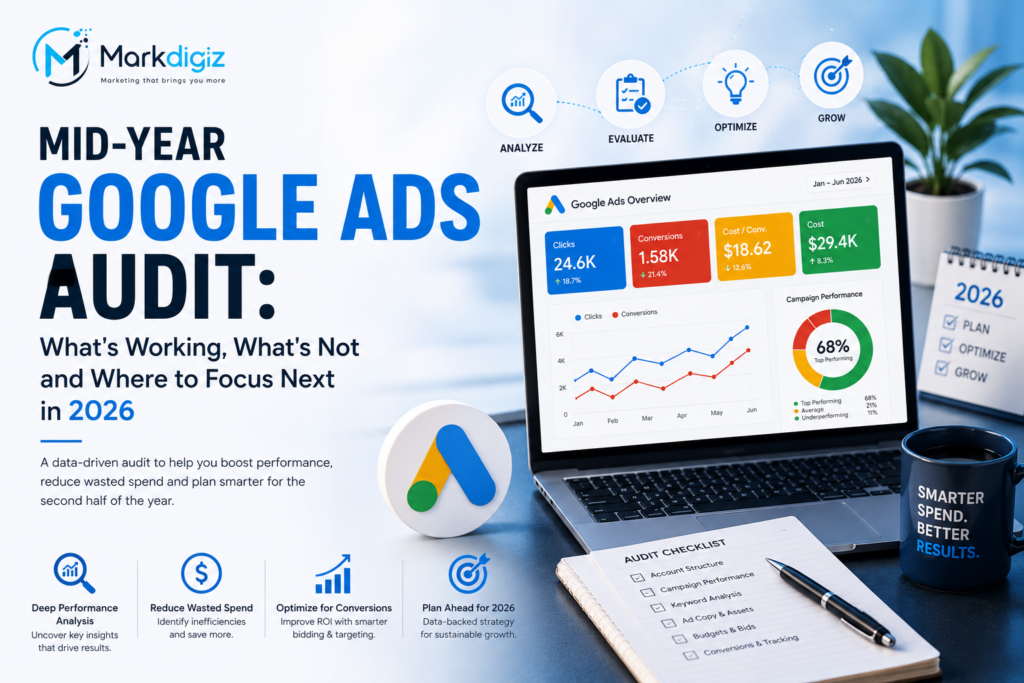
Your Mid-Year Google Ads Audit Checklist
Use this checklist to evaluate your account:
→ Campaigns align with current business goals
→ Budget is focused on profitable campaigns
→ Search terms are attracting qualified customers
→ AI features are improving—not hurting—performance
→ Landing pages are optimised for conversions
→ Conversion tracking accurately measures revenue
→ Performance Max campaigns have quality assets
→ Customer Match and Enhanced Conversions are enabled
→ Ad copy and creative have been refreshed recently
→ Reports focus on business outcomes—not just clicks and impressions
Final Thoughts
The second half of 2026 presents plenty of opportunities for businesses willing to review and refine their Google Ads strategy.
A successful audit isn’t about making dramatic changes overnight. It’s about understanding what’s working, identifying what isn’t, and focusing your budget where it can deliver the greatest impact. By reviewing your campaigns, improving your website, strengthening your conversion tracking, and using AI strategically, you can maximise your advertising investment and position your business for stronger results throughout the rest of the year.